Human Orbital Spaceflights

International Flight No. 201STS-89Endeavour (12)89th Space Shuttle missionUSA |
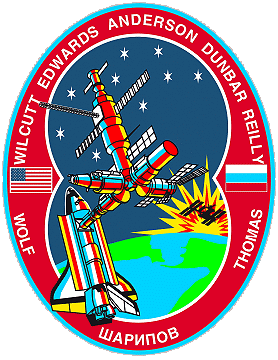 |
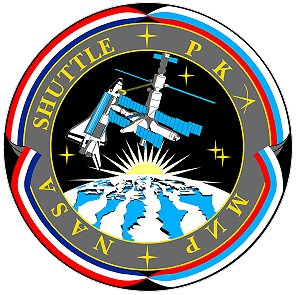 |
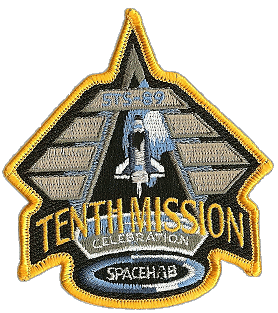 |
||
Launch, orbit and landing data
walkout photo |
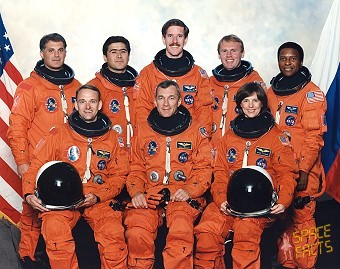 |
||||||||||||||||||||||||||||||||
alternative crew photo |
|||||||||||||||||||||||||||||||||
alternative crew photo |
|||||||||||||||||||||||||||||||||
alternative crew photo |
Crew
| No. | Surname | Given names | Position | Flight No. | Duration | Orbits | |
| 1 |  |
Wilcutt | Terrence Wade | CDR | 3 | 8d 19h 46m 54s | 138 |
| 2 | |
Edwards | Joe Frank, Jr. | PLT | 1 | 8d 19h 46m 54s | 138 |
| 3 | |
Reilly | James Francis II "J.R." | MS-1, PLC, EV-1 | 1 | 8d 19h 46m 54s | 138 |
| 4 | |
Anderson | Michael Philip | MS-2, EV-2, FE | 1 | 8d 19h 46m 54s | 138 |
| 5 | |
Dunbar | Bonnie Jeanne | MS-3, PLC, IV-1 | 5 | 8d 19h 46m 54s | 138 |
| 6 |  |
Sharipov | Salizhan Shakirovich | MS-4 | 1 | 8d 19h 46m 54s | 138 |
| 7 | |
Thomas | Andrew Sydney Withiel | MS-5 | 2 | 140d 15h 12m 02s | 2213 |
Crew seating arrangement
|
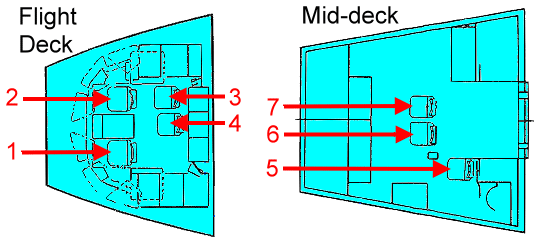 |
|
||||||||||||||||||||||||||||||||
Backup Crew
|
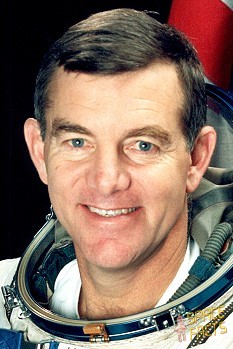 |
||||||||||
Hardware
| Orbiter : | OV-105 (12.) |
| SSME (1 / 2 / 3): | 2043-2A (1.) / 2044-2A (1.) / 2045-2A (1.) |
| SRB: | BI-093 / RSRM 64 |
| ET: | ET-90 (LWT-83) |
| OMS Pod: | Left Pod 04 (19.) / Right Pod 01 (26.) |
| FWD RCS Pod: | FRC 5 (12.) |
| RMS: | - |
| EMU: | EMU No. 3013 (PLSS No. 1013) / EMU No. 3016 (PLSS No. 1016) |
Flight
|
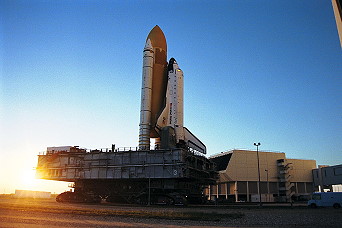
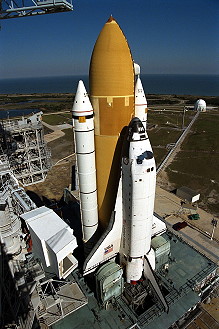
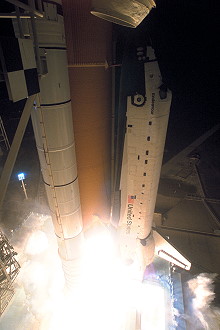
Launch from Cape Canaveral (KSC) and
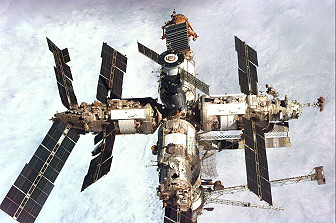
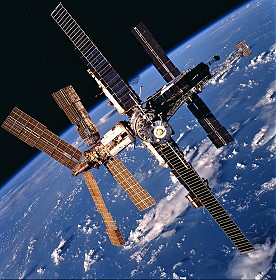
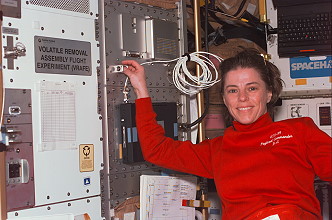
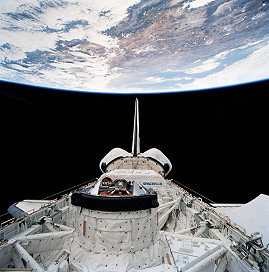
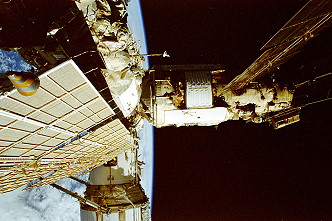
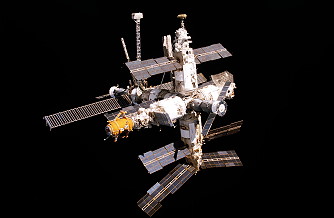
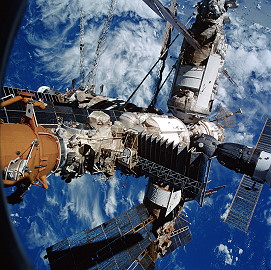
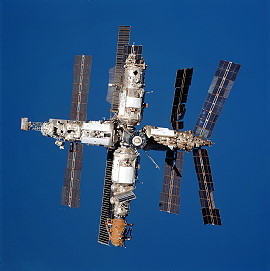
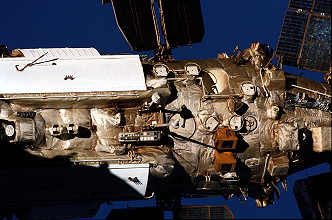
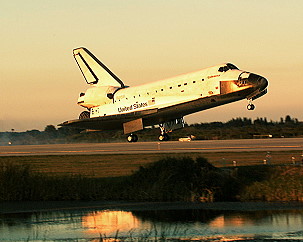
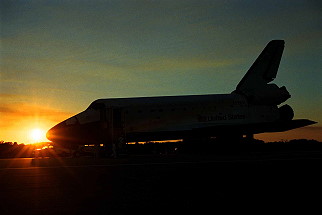
landing on Cape Canaveral (KSC), Runway 15. On May 22, 1997, mission managers announced Endeavour would fly STS-89 instead of Discovery. The launch was originally targeted for January 15, 1998, but changed first to no earlier than January 20, 1998 and then January 22, 1998, per request from the Russian space program to allow completion of activities on Mir. This was the eighth of nine planned missions to Mir and the fifth one involving an exchange of U.S. astronauts. Astronaut David Wolf, who has been on Mir since late September 1997, was replaced by Astronaut Andrew Thomas who spent approximately 4 months on the orbiting Russian facility before returning to Earth when Discovery docks to Mir in late May during STS-91. Endeavour again carried the SPACEHAB module in the payload bay of the orbiter. The double module configuration housed experiments to be performed by Endeavour's crew along with logistics equipment to be transferred to Mir. The prior Shuttle-Mir missions were STS-71, STS-74, STS-76, STS-79, STS-81, STS-84 and STS-86. The current Mir-24 mission began when cosmonauts Commander Anatoli Soloviyov and Flight Engineer Pavel Vinogradov were launched on August 05, 1997 in Soyuz TM-26 and docked with the Mir two days later. They returned to Earth in mid-February 1998. David Wolf began his stay on the orbiting Russian facility in late September with the docking of STS-86. David Wolf's replacement, Andrew Thomas, became a member of the Mir-25 crew when Commander Talgat Musabayev and Flight Engineer Nikolai Budarin relieved Anatoli Soloviyov and Pavel Vinogradov in mid-February 1998. Andrew Thomas returned home when Shuttle Discovery docked with Mir in June 1998. About two hours before the scheduled docking time on Flight Day Three of the mission, Endeavour reached a point about eight nautical miles (14.8 km) behind the Mir space station and conducted a Terminal Phase Initiation (TI) burn, beginning the final phase of the rendezvous. Endeavour closed the final eight nautical miles (14.8 km) to Mir during the next orbit. As Atlantis approaches, the shuttle's rendezvous radar system began tracking Mir and providing range and closing rate information to Endeavour. Endeavour' crew also began air-to-air communications with the Mir crew using a VHF radio. As Endeavour reached close proximity to Mir, the Trajectory Control Sensor, a laser ranging device mounted in the payload bay, supplemented the shuttle's onboard navigation information by supplying additional data on the range and closing rate. As Endeavour closed in on the Mir, the shuttle had the opportunity for four small successive engine firings to fine-tune its approach using its onboard navigation information. Identical to prior Mir dockings, Endeavour aimed for a point directly below Mir, along the Earth radius vector (R-Bar), an imaginary line drawn between the Mir center of gravity and the center of Earth. Approaching along the R-Bar, from directly underneath the Mir, allows natural forces to assist in braking Endeavour approach. During this approach, the crew began using a handheld laser ranging device to supplement distance and closing rate measurements made by other shuttle navigational equipment. The manual phase of the rendezvous began just as Endeavour reached a point about a half-mile (900 meters) below Mir. Commander Terrence Wilcutt flew the shuttle using the aft flight deck controls as Endeavour began moving up toward Mir. Because of the approach from underneath Mir, Terrence Wilcutt had to perform very few braking firings. However, if such firings were required, the Shuttle's jets were used in a mode called "Low-Z", a technique that uses slightly offset jets on Endeavour' nose and tail to slow the spacecraft rather than firing jets pointed directly at Mir. This technique avoids contamination of the space station and its solar arrays by exhaust from the shuttle steering jets. Using the centerline camera fixed in the center of Endeavour' docking mechanism, Terrence Wilcutt centered Endeavour' docking mechanism with the Docking Module mechanism on Mir, continually refining this alignment as he approached within 300 feet (91.4 meters) of the station. At a distance of about 170 feet (51.8 meters) from docking, Terrence Wilcutt stopped Endeavour and held stationkeep momentarily to adjust the docking mechanism alignment, if necessary. At that time, a final go or no-go decision to proceed with the docking was made by flight control teams in both Houston and Moscow. When Endeavour proceeded with docking, the shuttle crew used ship-to-ship communications with Mir to inform the Mir crew of the Shuttle's status and to keep them informed of major events, including confirmation of contact, capture and the conclusion of damping. Damping, the halt of any relative motion between the two spacecraft after docking, was performed by shock absorber-type springs within the docking device. Mission Specialist James Reilly had to oversee the operation of the Orbiter Docking System from onboard Atlantis. The docking of Endeavour and Mir took place on January 24, 1998 at 20:14 UTC. With the two commanders opening the spacecraft hatches Andrew Thomas officially joined the Mir-25 crew. At the same time, David Wolf became a member of the STS-89 crew and began moving his personal belongings back into Endeavour. Andrew Thomas thought his Sokol pressure suit did not fit, and the crew exchange was allowed to proceed only after David Wolf's suit was adjusted to fit Andrew Thomas. Once on Mir, Andrew Thomas was able to make adequate adjustments to his own suit (which would be worn should the crew need to return to Earth in the Soyuz capsule) and this remained on Mir with him. Common scientific work of 4d 20h 43m (January 24, - January 29, 1998) with the 24th Mir resident crew followed. During the mission, more than 3,175 kilograms (7,000 lb) of experiments, supplies and hardware were transferred between the two spacecraft. The Endeavour brought supplies and equipment to the Mir (i.e. two computers, a cooling system and a compressor). The American long duration astronauts performed the majority of the experiment operations while on orbit, while their Russian counterparts primarily concern themselves with station upkeep and maintenance. All are equal contributors to the joint program and have dedicated their time during intensive training in both the US and Russia, as well as by staying on board the Mir for several months. Norman Thagard was the American who took the first step in this era of joint space cooperation by staying onboard the Mir for 116 days (which set the space duration record for an American). He was also the only astronaut to travel to Mir on a Soyuz rocket, with his Mir-18 crewmates. Norman Thagard was followed by Shannon Lucid, who stayed on the Mir for 188 days, breaking Norman Thagard's record and setting a new record as the longest stay in space for a woman. John Blaha replaced Shannon Lucid in September 1996. Jerry Linenger replaced John Blaha in January 1997. Michael Foale replaced Jerry Linenger in May 1997 and he was replaced by David Wolf in September 1997. These American crewmembers' stays on Mir have demonstrated to the world the commitment of both countries to work together for the betterment of human kind through scientific advancement. STS-89 marked the eighth of nine planned missions to dock an American Space Shuttle with Russia's Mir space station. This mission delivered Astronaut Andrew Thomas to Mir as the NASA 7 astronaut and will return David Wolf to Earth. Andrew Thomas stayed on board until STS-91, the ninth and final US Shuttle mission to the Mir space station, returned him to Earth. In addition to the NASA 7 crewmember, the Shuttle transported approximately 6,000 pounds of research equipment and supplies to the station. During the docked phase of STS-89, astronauts and cosmonauts transferred from the Mir space station to the Shuttle the science samples collected by the Mir-24/NASA 6 crew. After return to Earth, the samples were analyzed by researchers on the ground. The Shuttle crew also transferred hardware and supplies to Mir in support of the health and well-being of the Mir-25/NASA 7 crew, station maintenance, and future investigations on the Mir. This research focused on 27 studies in the areas of advanced technology, Earth sciences, human life sciences, microgravity research, and ISS risk mitigation. SPACEHAB Payloads included the Advanced X-Ray Detector (ADV XDT), the Advanced Commercial Generic Bioprocessing Apparatus (ADV CGBA), the EORF, Mechanics of Granular Materials (MGM) Experiment, Intra-Vehicular Radiation Environment Measurements by the Real-Time Radiation Monitor (RME-1312), Space Acceleration Measurement System (SAMS), VOA and the Volatile Removal Assembly prototype for the ISS Water Recovery System. Middeck Payloads included the Microgravity Plant Nutrient Experiment MPNE, the Shuttle Ionospheric Modification with Pulsed Local Exhaust (SIMPLEX), the Closed Equilibrated Biological Aquatic System (CEBAS), the TeleMedicine Instrumentation Pack (TMIP), Global Positioning System Development Test Objective (GPS DTO), the Human Performance (HP) Experiment, MSD, EarthKAM, Orbiter Space Vision System (OSVS) Shuttle Condensate Collection (RME-1331), the Thermo-Electric Holding Module (TEHM), the Space Linear Acceleration Mass Measurement Device (DSO 914), the Co-Culture Experiments (CoCult) and the Biochemistry of 3-D Tissue Engineering (BIO3D). Get Away Special Experiments include the University of Michigan G-093 - Vortex Ring Transit Experiment (VORTEX), the German Aerospace Center and University Giessen G-141 - Structure of Marangoni Convection in Floating Zones Payload, the German Aerospace Center and the Technical University of Clausthal G-145 Glass Fining Experiment and the Chinese Academy of Sciences G-432 canister containing 5 crystal growth and material sciences experiments. The Closed Equilibrated Biological Aquatic System (CEBAS) was a secondary middeck payload which fitted inside a standard middeck locker. The payload hardware was developed by the German Space Agency (DLR formerly DARA). The CEBAS Minimodule, a habitat for aquatic organisms, enabled scientists to conduct various gravity-related experiments in the areas of zoology, botany and developmental biology, as well as in interdisciplinary areas such as scientific research on artificial ecosystems. This research was carried out for the most part on biological objects with various research goals and emphasis. CEBAS provided energy and food for animals (fish and snails) as well as plants. The experiment supported a mission duration of up to 3 weeks (including launch delays and contingency days). The organisms returned alive, which means that no chemical fixation of the samples was foreseen. The main goal of the Microgravity Plant Nutrient Experiment (NPNE) was to test a nutrient delivery technology that supported plant growth in space. Plants were grown in MPNE to validate the use of a porous tube delivery system and not specifically for biological research. MPNE was stowed in a standard Space Shuttle middeck locker with an internal layer of 1/2 inch pyrell foam. The MPNE hardware included a plant enclosure, fluid system, light bank, Command and Data Management System (CDMS), power converter, batteries, instrumentation, fans and payload container. An education R&D program called EarthKAM, building on the success of KidSat, allowed these students to gain a new perspective on planet Earth by operating a digital camera mounted in the overhead window of the Space Shuttle. The students engage in selecting sites around the world to be photographed during Shuttle flights, participate in solving real-world problems that arise, and use tools of modern science, (computers and the Internet) to study the images and the Earth Science processes that they illustrate. EarthKAM fosters a cooperative, team environment that models both space operations and scientific research, and promotes student growth, discovery and achievement. The Mechanics of Granular Materials experiment was aimed at understanding the behavior of granular materials - such as sand or salt - under very low confining pressure. Confining pressure is the force that keeps a granular material "sticking together". The experiment had applications in a wide range of fields, including earthquake engineering; coastal and off-shore engineering; mining; transportation of granular materials; soil erosion; the handling of granular materials such as grains and powders; off-road vehicles; geology of the Earth; and planetary geology and exploration. Findings from the experiment may lead to improved selection and preparation of building sites, better management of undeveloped land, and improved handling of materials in chemical, agricultural and other industries. There are many examples of encounters with granular pressures in everyday life: Expose a vacuum-packed coffee bag to air, and the contents suddenly change from a brick-like solidity to behaving almost like a liquid. On Earth, soil can behave much the same way: An earthquake's shock waves can turn compacted, rock-like earth into liquid as microscopic gaps between soil grains expand and contract, forcing water or air in and out of the soil. The STS-89 Mir-docking mission transported the ASTROCULTURE flight unit to orbit. Once the Shuttle had docked with Mir, the facility was transferred to the Russian space station to begin an 80-day experiment to determine if wheat plants will produce seed in microgravity. The ASTROCULTURE unit has flown on five previous Shuttle flights - USML-1, USML-2 and the SPACEHAB 1, 2 and 3 missions - to validate the performance of plant growth technologies in the unique environment of space. Each of the flight experiments has involved the incremental addition of important subsystems required to provide the necessary environmental control for plant growth. During these flights, lighting, temperature, humidity, nutrient composition and supply, and carbon dioxide and atmospheric contaminant control subsystems were successfully evaluated. The Mir experiment was the first long-term test of ASTROCULTURE. The X-ray detector was one of the essential elements for this facility. It detects X-rays reflected from protein crystals and helps to determine their structure, or makeup. The X-ray Detector Test was conducted during STS-89 to measure the sensitivity of the device to background space radiation and determine any detrimental effect this radiation may have on the instrument. The Diffusion-Controlled Crystallization Apparatus for Microgravity (DCAM) experiment which was carried aboard Endeavour was designed to grow protein crystals at slow, controlled rates in the microgravity environment of space. Researchers are using this apparatus to try to grow larger and purer crystals in the pursuit of therapeutic research to counter the Herpes virus, fundamental virus mapping and to develop new drug delivery systems. Gaseous Nitrogen Dewar: Frozen protein samples were transported to the Russian Mir space station in a Gaseous Nitrogen Dewar on STS-89. This investigation was expected to contribute to the understanding of why it is possible for researchers to grow larger and more perfectly formed protein crystals in the microgravity environment of space than on Earth. Once Endeavour was ready to undock from Mir, the initial separation was performed by springs that gently pushed the Shuttle away from the docking module. Both the Mir and Endeavour were in a mode called "free drift" during the undocking, a mode that had the steering jets of each spacecraft shut off to avoid any inadvertent firings. Once the docking mechanism's springs had pushed Endeavour away to a distance of about two feet (61 centimeters) from Mir, where the docking devices were clear of one another, Endeavour's steering jets were turned back on and fired in the Low-Z mode to begin slowly moving away from Mir. The shuttle continued to back away through a corridor similar to that used during approach until it reached a distance of approximately 240 feet (73.2 meters) below the Mir. Pilot Joe Edwards then performed a flyaround of the station before a final maneuvering burn is performed and Endeavour departed the vicinity of the station. |
Note
Photos / Graphics
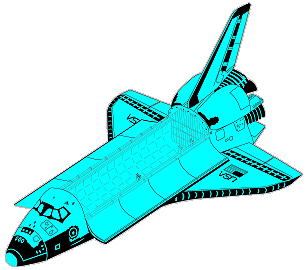 |
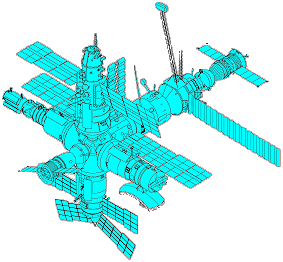 |
 |
 |
 |
 |
 |
 |
 |
 |
 |
 |
 |
 |
 |
 |
 |
 |
 |
 |
 |
|
Earth observation photos |
|
| © |  |
Last update on March 27, 2020.  |
 |