Human Orbital Spaceflights

International Flight No. 158STS-57Endeavour (4)56th Space Shuttle missionUSA |
 |
 |
Launch, orbit and landing data
walkout photo |
 |
||||||||||||||||||||||||||||
alternative crew photo |
Crew
| No. | Surname | Given names | Position | Flight No. | Duration | Orbits | |
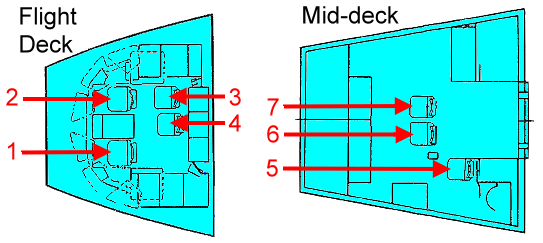
| 1 |  |
Grabe | Ronald John | CDR | 4 | 9d 23h 44m 55s | 155 |
| 2 | |
Duffy | Brian | PLT, IV-1 | 2 | 9d 23h 44m 55s | 155 |
| 3 | |
Low | George David | MS-1, PLC, EV-1, RMS | 3 | 9d 23h 44m 55s | 155 |
| 4 | |
Sherlock | Nancy Jane | MS-2, RMS, FE | 1 | 9d 23h 44m 55s | 155 |
| 5 | |
Wisoff | Peter Jeffrey Kelsay "Jeff" | MS-3, EV-2 | 1 | 9d 23h 44m 55s | 155 |
| 6 | |
Voss | Janice Elaine | MS-4 | 1 | 9d 23h 44m 55s | 155 |
Crew seating arrangement
|
 |
|
||||||||||||||||||||||||||||
Hardware
| Orbiter : | OV-105 (4.) |
| SSME (1 / 2 / 3): | 2019 (12.) / 2034 (2.) / 2017 (8.) |
| SRB: | BI-059 / RSRM 32KM |
| ET: | ET-58 (LWT-51) |
| OMS Pod: | Left Pod 03 (15.) / Right Pod 04 (11.) |
| FWD RCS Pod: | FRC 5 (4.) |
| RMS: | 303 (5.) |
| EMU: | EMU No. 2018 (PLSS No. 1014) / EMU No. 2020 (PLSS No. 1006) |
Flight
|
Launch from Cape Canaveral (KSC) and
landing on Cape Canaveral (KSC), Runway 33. Low clouds at Cape Canaveral and bad weather at the emergency landing places forced a scrub on June 20, 1993. The primary objective of STS-57 was to support the NASA's commercial development of space program by providing additional access to crew-tended, mid-deck locker or experiment rack space. This access was necessary to test, demonstrate or evaluate techniques or processes in microgravity. For this reason, NASA leased a privately-developed mid-deck augmentation module known as SPACEHAB. The experiments flying inside this first SPACEHAB included investigations ranging from drug improvement, feeding plants, cell splitting, the first soldering experiment in space by American astronauts and high temperature melting of metals. In addition, a rendezvous with the European Space Agency's European Carrier (EURECA) satellite was scheduled to retrieve the free-flyer. The EURECA free-flying experiment platform was retrieved on the fourth day of STS-57. EURECA was deployed from Atlantis on STS-46 on August 01, 1992. During its approximately 10-month stay in orbit, EURECA has supported investigations in processing metallurgical samples, growing crystals and conducting biological and biochemical studies. Several weeks before the STS-57 launch, EURECA controllers lowered the spacecraft's orbit from 270 nautical miles (500 km) high to 257 nautical miles (300 km) in preparation for the retrieval. Beginning on flight day one, a series of engine firings adjusted Endeavour's catch-up rate so that on the morning of flight day four, a final altitude adjustment burn moved Endeavour up to the 257-nautical-mile (300 km) EURECA orbit. During the catch-up maneuvers, Endeavour's onboard navigational star trackers sighted on EURECA during the best lighting period, from noon to sunset of each orbit, to provide the most accurate course correction information for each maneuver. For the final mid-course corrections, the crew used Endeavour's rendezvous radar to refine their information about the position of EURECA in relation to Endeavour. For about the final one and a half miles of Endeavour's approach to EURECA, Commander Ronald Grabe flew the Shuttle's maneuvers manually. David Low grasped the 5-ton EURECA with the Shuttle's robot arm and lowered the platform without latching its dual antennas. An improperly installed electrical connector on Endeavour's Remote Manipulator System (RMS) arm (installed 180 degrees off its correct position) prevented EURECA from recharging its batteries with orbiter power. A flight rule requiring antenna stowage was waived and EURECA was lowered into the payload bay without latching its antenna. Mission control decided to look for the antennas while the planned spacewalk. The only EVA in this mission was performed by David Low and Peter Wisoff on June 25, 1993 (5h 50m), to make final tests for repairing works on the Hubble Space Telescope. The first task was safely secure EURECA's dual antennas against the science satellite during the spacewalk. David Low was mounted on a foot restraint on the end of Endeavour's robotic arm while Mission Specialist Nancy Sherlock positioned the arm so David Low could gently push the arms against EURECA's latch mechanisms. Payload controllers then drove the latches to secure each antenna. During the remaining time, David Low and Peter Wisoff first took turns in a foot restraint mounted on the end of the robot arm, holding their fellow crew member in various ways to imitate moving a large, inanimate piece of equipment. Next, they investigated different methods of managing their safety tethers while mounted in the robot arm restraint. Another objective was to have each crew member, mounted in the robot arm restraint, practice aligning their fellow crew member into a foot restraint mounted on the side of the cargo bay, simulating the task of aligning a large object into a tightly fitting restraint. The crew members also practiced working with various tools while in the robot arm restraint and gauge the ability of the restraint to hold them steady as they tighten or loosen a bolt. The STS-57 spacewalk assisted in refining several procedures being developed to service the Hubble Space Telescope on mission STS-61 in December 1993. The SPACEHAB Space Research Laboratory was located in the forward end of the Shuttle orbiter cargo bay and was accessed from the orbiter middeck through a tunnel adapter connected to the airlock. SPACEHAB weighed 9,628 pounds (4,367 kg), was 9.2 feet (2.80 meters) long, 11.2 feet (3.41 meters) high and 13.5 feet (4.11 meters) in diameter. It increased pressurized experiment space in the Shuttle orbiter by 1100 cubic feet (31.15 cubic meters), quadrupling the working and storage volume available. Environmental control of the laboratory's interior maintained ambient temperatures between 65 and 80 degrees Fahrenheit (18.1 and 26.7 degrees Celsius). The laboratory had a total payload capacity of 3000 pounds (1,360 kg) and in addition to facilitating crew access, provided experiments with services such as power, temperature control and command/data functions. Other services, such as late access/early retrieval, also were available. The SPACEHAB Space Research Laboratory could provide various physical accommodations to users based on size, weight and other requirements. Experiments were commonly integrated into the laboratory in Shuttle middeck- type lockers or SPACEHAB racks. The laboratory can accommodate up to 61 lockers, with each locker providing a maximum capacity of 60 pounds (27.2 kg) and 2.0 cubic feet (0.06 cubic meter) of volume. The laboratory also could accommodate up to two SPACEHAB racks, either of which can be a "double-rack" or "single-rack" configuration, but each rack used reduces the number of usable locker locations by 10 lockers. A "double-rack" provided a maximum capacity of 1250 pounds (567 kg) and 45 cubic feet (1.27 cubic meter) of volume, whereas a "single-rack" provides half of that capacity. The "double-rack" was similar in size and design to the racks planned for use in the space station. The experiments included studying body posture, the spacecraft environment, crystal growth, metal alloys, wastewater recycling and the behavior of fluids. Among the experiments was an evaluation of maintenance equipment that may be used on the ISS. The diagnostic equipment portion of the Tools and Diagnostics System experiment was performed by Nancy Sherlock. Using electronics test instruments including an oscilloscope and electrical test meter, Nancy Sherlock conducted tests on a mock printed circuit board and communicated with ground controllers via computer messages on suggested repair procedures and their results. In addition, Brian Duffy and Peter Wisoff ran experiments in transferring fluids in weightlessness without creating bubbles in the fluid. The experiment, called the Fluid Acquisition and Resupply Experiment, or FARE, studied filters and processes that may lead to methods of refueling spacecraft in orbit and transfers water between two foot-diameter transparent tanks on Endeavour’s middeck, engineers can evaluate how the fluids behave while the shuttle's steering jets are fired for small maneuvers. Janice Voss worked on the Liquid Encapsulated Melt Zone, or LEMZ, experiment which uses a process called floating zone crystal growth. The low-gravity conditions of space flight permit large crystals to be grown in space. Ronald Grabe, Brian Duffy and Janice Voss participated in the Neutral Body Position study. Flight surgeons have noted on previous flights that the body's basic posture changes while in microgravity. This postural change, sometimes called the "zero-g crouch", is in addition to the one- to two-inch lengthening of the spine during space missions. To better document this phenomenon over the duration of a space mission, still and video photography of crew members in a relaxed position are taken early and late in the mission. Researchers will include these findings in the specifications for design of future spacecraft to make work stations and living areas efficient and more comfortable for astronauts. Nancy Sherlock stepped through the electronics procedures portion of the Human Factors Assessment this morning. She set up a work platform then hooked up a notebook computer and went through a simulated computer procedure for a space station propulsion system. On June 28, 1993, Nancy Sherlock performed an impromptu plumbing job on the Environmental Control Systems Flight Experiment, a study of wastewater purification equipment that may be used aboard future spacecraft. EFE uses a mixture of water and potassium iodide to simulate wastewater. The solution is pumped through a series of filters to purify it. During the flight, experimenters have seen a reduced flow of water through the device and opted to perform the maintenance procedure. Nancy Sherlock loosened a fitting on one water line inside the experiment, wrapped the loose fitting with an absorbent diaper, and, using a laptop computer on board, turned a pump on the experiment into reverse for about 20 minutes in an attempt to flush out the clog. Nancy Sherlock then retightened the fitting and put the experiment back into normal operation for ground experimenters, who will now spend about an hour and a half watching it run to see if the clog has been cleared. The Superfluid Helium On-Orbit Transfer (SHOOT) Flight Demonstration, managed by NASA's Goddard Space Flight Center, was an experiment designed to develop and demonstrate the technology required to resupply liquid helium containers in space. In addition, components developed for SHOOT may find use in future space cryogenic (low temperature) systems. Many detectors for astrophysics and observation of Earth require cooling to extremely low temperatures to achieve high sensitivity. To achieve these low temperatures, liquid helium is used for cooling. By allowing the liquid to slowly vaporize, an instrument may be cooled to temperatures below 2 Kelvin (K) (-519 °F, - 271 °C). The SHOOT experiment consisted of two vacuum insulated Thermos-like containers, called dewars, each holding 55 gallons (207 liters) of liquid helium. The two dewars were connected by a vacuum insulated transfer line. Liquid helium was pumped from one dewar to another at rates from 1.3 to 4.4 gallons per minute (300 to 1000 liters per hour). Each of dewar's plumbing, including pumps, valves and instrumentation, was nearly identical so that each dewar in turn may act as the supply or receiver dewar. SHOOT consisted of experiments in liquid management in low gravity, filling a large gap in the knowledge of the behavior of cryogens in space. The problem of controlling the position of cryogenic liquids in orbit is a difficult one. The evaporating gas must be allowed to leave the dewar, but the liquid must be contained. On the ground this is easy since the liquid is denser than the gas and gravity holds it in the bottom of the tank. In a low gravity environment, the liquid location is not well defined. Surface tension, heat inputs and the small residual accelerations of a spacecraft all play a role in positioning the liquid. The Air Force Maui Optical Site (AMOS) tests allowed ground- based electro-optical sensors located on Mt. Haleakala, Maui, Hawaii, to collect imagery and signature data of the orbiter during cooperative overflights. The scientific observations made of the orbiter, while performing reaction control system thruster firings, water dumps or payload bay light activation, and were used to support the calibration of the AMOS sensors and the validation of spacecraft contamination models. The AMOS tests had no payload unique flight hardware and only required that the orbiter be in predefined attitude operations and lighting conditions. The Shuttle Amateur Radio Experiment-II (SAREX-II) provided for public participation in the space program, supports educational initiatives and demonstrates the effectiveness of making contact between the Space Shuttle and low-cost amateur "ham" radio stations on the ground. On STS-57, Pilot Brian Duffy, call sign N5WQW, and Janice Voss, call sign, operated SAREX. Brian Duffy has operated SAREX in flight before during Shuttle mission STS-45. Due to bad weather at Cape Canaveral the landing was delayed 24 hours. |
EVA data
| Name | Start | End | Duration | Mission | Airlock | Suit | |
| EVA | Low, David | 25.06.1993, 13:07 UTC | 25.06.1993, 18:57 UTC | 5h 50m | STS-57 | Endeavour | EMU No. 2018 |
| EVA | Wisoff, Peter | 25.06.1993, 13:07 UTC | 25.06.1993, 18:57 UTC | 5h 50m | STS-57 | Endeavour | EMU No. 2020 |
Photos / Graphics
 |
 |
 |
 |
 |
 |
 |
 |
 |
 |
 |
 |
 |
 |
Earth observation photos |
|
more EVA photos |
|
| © |  |
Last update on June 19, 2023.  |
 |