Human Orbital Spaceflights

International Flight No. 179STS-69Endeavour (9)71st Space Shuttle missionUSA |
 |
 |
 |
||
Launch, orbit and landing data
walkout photo |
 |
||||||||||||||||||||||||||||
alternative crew photo |
|||||||||||||||||||||||||||||
alternative crew photo |
Crew
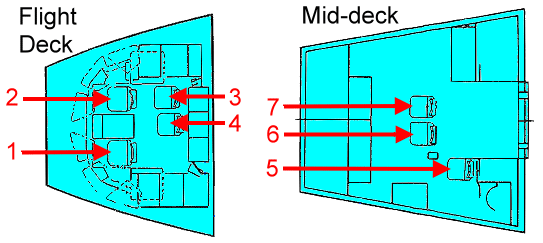
| No. | Surname | Given names | Position | Flight No. | Duration | Orbits | |
| 1 |  |
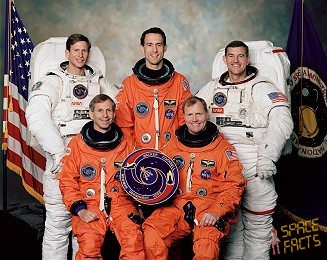
Walker | David Mathieson | CDR | 4 | 10d 20h 28m 55s | 171 |
| 2 | |
Cockrell | Kenneth Dale "Taco" | PLT | 2 | 10d 20h 28m 55s | 171 |
| 3 | |
Voss | James Shelton | MS-1, PLC, EV-1 | 3 | 10d 20h 28m 55s | 171 |
| 4 | |
Newman | James Hansen | MS-2, RMS, FE | 2 | 10d 20h 28m 55s | 171 |
| 5 | |
Gernhardt | Michael Landon | MS-3, EV-2, RMS | 1 | 10d 20h 28m 55s | 171 |
Crew seating arrangement
|
 |
|
||||||||||||||||||||||||
Hardware
| Orbiter : | OV-105 (9.) |
| SSME (1 / 2 / 3): | 2035 (2.) / 2109 (15.) / 2029 (12.) |
| SRB: | BI-074 / RSRM 48KM |
| ET: | ET-72 (LWT-65) |
| OMS Pod: | Left Pod 04 (16.) / Right Pod 05 (7.) |
| FWD RCS Pod: | FRC 5 (9.) |
| RMS: | 303 (10.) |
| EMU: | EMU No. 2042 (PLSS No. 1009) / EMU No. 2041 (PLSS No. 1010) |
Flight
|
Launch from Cape Canaveral (KSC) and
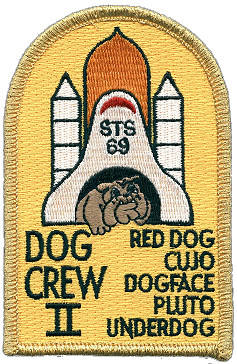
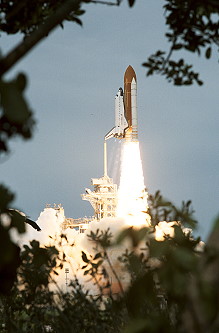
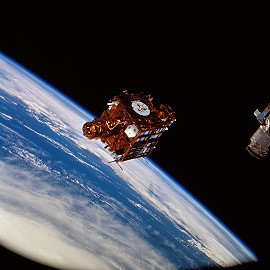
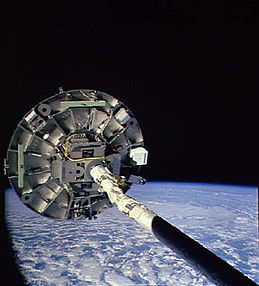
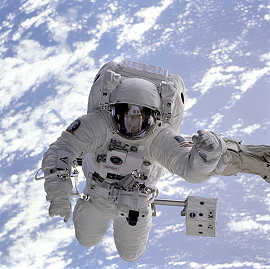
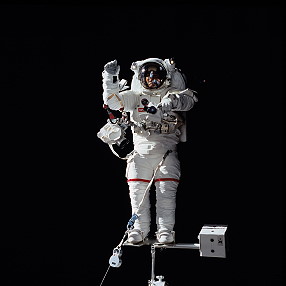
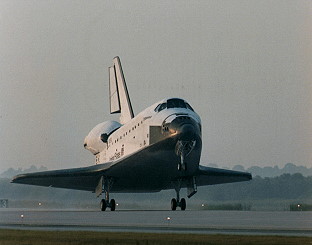
landing on Cape Canaveral (KSC), Runway 33. The launch was originally set for August 05, 1995 but postponed indefinitely to allow further review of solid rocket motor nozzle joint hardware from two previous missions, STS-70 and STS-71. Inspection team formed to assess significance of gas path in nozzle internal joint number 3, extending from insulation in the motor chamber to, but not past, primary O-ring, and resulting in slight heat effect to primary O-ring seal. Team concluded nozzle joint design was sound and that gas paths were being created when insulation material, known as RTV or Room Temperature Vulcanizing, was applied. Small air pockets were forming in thermal insulation that could later become pathways for hot gas during motor operation. Attention then focused on developing procedures to allow Non-Destructive Evaluation (NDE) inspection of insulation material on specific joints as well as testing repair techniques. Repairs were completed on STS-69 nozzle joint insulation at the pad and new launch date of August 31, 1995 set. Nozzle joint insulation on boosters assigned to Missions STS-73 and STS-74 also repaired at KSC, but work did not impact schedule. August 31, 1995 launch try was scrubbed about five and a half hours before liftoff due to failure of one of orbiter's three fuel cells. Fuel cell No. 2 indicated higher than allowable temperatures during activation as countdown proceeded. The fuel cell was removed and replaced. The fifth Space Shuttle flight of 1995 was highlighted by the deployment and retrieval of two scientific spacecraft and a spacewalk to practice for Space Station activities and evaluate space suit design modifications. The STS-69 mission marked the second flight of the Wake Shield Facility-2 (WSF-2), a 12-foot (3.66 meters) diameter, stainless steel disk which was deployed and retrieved using the Shuttle robot arm. While the WSF flew free of the Shuttle, it generated an "ultra-vacuum" environment in space within which to grow thin semiconductor films for next-generation advanced electronics. The commercial applications for these new semiconductors include digital cellular telephones, high-speed transistors and processors, fiber optics, opto-electronics and high-definition television. The SPARTAN 201 free-flyer was making its third flight aboard the Shuttle. The SPARTAN 201 mission was a scientific research effort aimed at the investigation of the interaction between the Sun and its outflowing wind of charged particles. SPARTAN goal was to study the outer atmosphere of the Sun and its transition into the solar wind that constantly flows past the Earth. Two astronauts left Endeavour's crew cabin for about six hours to perform several tasks that will broaden NASA's experience base for building and maintaining the Space Station and for other future spacewalks. The astronauts performed a number of tasks designed to evaluate and verify specific assembly and maintenance tasks for the Space Station. The spacewalk also evaluated spacesuit design modifications to protect spacewalkers from the extremely cold space environment. STS-69 also was the second flight of a "dog crew", a flight crew tradition that began on STS-53, on which both David Walker and James Voss flew. As the "Dog Crew II", each STS-69 astronaut adopted a dogtag or nickname: David Walker was Red Dog; Kenneth Cockrell was Cujo; James Voss, Dog Face; James Newman, Pluto, and Michael Gernhardt, Under Dog. A special "Dog Crew II" patch was designed. The SPARTAN 201-03 mission was a scientific research effort aimed at the investigation of the interaction between the Sun and its outflowing wind of charged particles. SPARTAN's goal was to study the outer atmosphere of the Sun and its transition into the solar wind that constantly flows past the Earth. The mission involved the deployment and operation of the free-flying SPARTAN spacecraft from Space Shuttle Endeavour. This mission - the third for SPARTAN - was intended to coincide with the passage of the Ulysses spacecraft over the Sun's north polar region. As the Ulysses spacecraft passed high over the north pole of the Sun, its instruments were sampling the physical properties of electrons, protons, and ions in the solar wind flowing past the spacecraft. These properties included variations of temperature, density, ionic composition, and magnetic and velocity fields. At the same time, intensive collaborative observations of the source of the solar wind at the Sun were planned, including SPARTAN 201-03 and a variety of other ground and space-based experiments. The primary objective of the SPARTAN 201-03 mission was to understand the physical circumstances of the corona at the Sun during the time of the Ulysses north polar passage. It had been suspected for about 20 years that the polar regions of the Sun were sources for high speed solar wind streams. This hypothesis was finally confirmed by measurements made by the Ulysses spacecraft during the south polar passage in September 1994. The SPARTAN solar viewing instruments were used to define conditions at the base of the heliosphere where the solar wind has its origins. The great mysteries yet to be solved are what process accelerates the solar wind and, still more basic, why the corona is so much hotter than the underlying layers of the Sun. After the SPARTAN was deployed by the Shuttle with RMS operated by Michael Gernhardt, the spacecraft operated on its own for 43 hours, achieving a maximum distance of 70 to 100 nautical miles (129 to 185 km) from the Shuttle at mid-mission. After its independent operation, SPARTAN was placed into a safe-hold condition, and was recovered and placed into the Shuttle cargo bay. As the orbiter approached free-flying spacecraft, it was rotating slowly and located in a different attitude than expected for retrieval. David Walker had to maneuver Endeavour around SPARTAN and Michael Gernhardt was able to grapple it with the RMS. The Wake Shield Facility (WSF) was a 12-foot (3.66 meters) diameter, stainless steel disk designed to generate an "ultravacuum" environment in space within which to grow thin films for next generation advanced electronics. The principle objectives of the WSF-2 mission included: performance of WSF as a free-flyer far enough away from the Orbiter to achieve and characterize for the first time an uncontaminated "ultra-vacuum" in low-Earth orbit; and, demonstrate the feasibility of epitaxial growth of high quality compound semiconductor thin films and heterostructures required for future advanced electronic and optoelectronic devices as part of the four-flight WSF proof-of-concept program. The first flight of the WSF-1 occurred aboard Discovery on STS-60 in February of 1994. Because of difficulties in attitude control, experiments were performed only while WSF-1 was attached to the Shuttle's robot arm. Although the results of WSF-1 did demonstrate wake formation and thin film growth, water vapor contamination from the Shuttle interfered with the achievement of "ultra-vacuum" necessary for achieving the growth of semi-conductor materials superior to those that can be grown on Earth. As a free-flying platform, the WSF's wake side - the "ultra-clean side" - was used on this mission primarily for ultra-pure thin-film growth. The ram side - the "dirty side" - housed the avionics platform and also was used to accommodate other experiments and space technology applications. The ram side had more than 65 square feet (6 square meters) of usable surface in the form of the outer shield, which will support other space payloads. The Wake Shield Facility (WSF) looked like a saucer shaped satellite. The WSF hardware consisted of the Shuttle Cross Bay Carrier mounting equipment and the Free Flyer. The Carrier remained in the Shuttle and had a latch system which held the Free Flyer to it. The Shuttle's robot arm was used to remove the Free Flyer from the Carrier and deploy it into space. The WSF followed behind the Shuttle at a station-keeping distance of 30 nautical miles (55 km). The Free Flyer was a fully-equipped spacecraft on its own, with cold gas propulsion for separation from the Shuttle and a momentum bias attitude control system. Sixty kilowatt-hours of energy, stored in silver-zinc batteries, power the thin-film growth furnaces, substrate heaters, process controllers, and a sophisticated array of vacuum characterization devices, including mass spectrometers and total pressure gauges. Weighing approximately 8,100 pounds (3,674 kg) altogether, (the Free Flyer itself is 4,350 pounds = 1,973 kg), the WSF occupied one quarter of the Shuttle payload bay. Process control equipment and vacuum characterization equipment were located on the back (wake side) of the free flyer, while the controller electronics, attitude control system, batteries and support equipment were located on the front (ram side). The WSF radio frequency communications system routed telemetry and commands, including video, from the Cross Bay Carrier, through the Shuttle systems to both WSF ground personnel and the flight crew. On Flight Day 4, the WSF was grappled by the Shuttle arm with James Newman at the controls and removed from the Cross-Bay Carrier. The WSF was positioned by the arm to be scoured by the highly reactive atomic oxygen found in LEO, and by the Sun's heat. The cleaning lasted several hours. Some systems tests were run during this cleaning cycle, such as communications checks between the Carrier and the Free Flyer, checks of the Free Flyer batteries, and activation of the primary video camera on the wake side of the Free Flyer. After the cleaning was done, the arm moved the WSF to the release position near the center of the payload bay. The Free Flyer separated from the arm and moved under its own nitrogen gas thrusters to about 30 nautical miles (55 km) behind the Shuttle to isolate it from Shuttle contamination sources (such as water dumps, fuel cell purges and engine firings). On Flight Day 7, the Shuttle rendezvoused with the Free Flyer. Every member of the STS-69 crew had a vital role to play during the WSF rendezvous and capture, and the integral plume experiment. During approach, David Walker and Kenneth Cockrell flew Endeavor in a complex series of maneuvers designed to expose the WSF to carefully controlled thruster exhaust plumes. James Newman and Michael Gernhardt coordinated the plume experiment initiation and data acquisition, and James Voss tracked the WSF position by video. After the astronauts recaptured the WSF, it stayed on the Shuttle arm above the payload bay during the astronaut sleep period for extended WSF environmental measurements. On Flight Day 8, the CHAWS experiment was performed. The astronauts positioned the WSF to the point above the overhead windows and maneuvered it to gather plasma flow data around the WSF. The Auroral Photography Experiment B camera was used in support of the plasma flow studies to view the Shuttle glow phenomenon on the CHAWS plasma probe from the Shuttle's aft flight deck windows. Plasma flow data were acquired for two full orbits after which the WSF was re-stowed for return to Earth. The only EVA in this mission was performed by James Voss and Michael Gernhardt on September 16, 1995 (6h 46m) to test assembly techniques for the ISS (EVA Development Flight Test - EDFT-2). The extravehicular activity supported four different Detailed Test Objectives (DTOs). DTO 833 was designed to evaluate spacesuit design modifications to protect spacewalkers from the extremely cold space environment and their ability to perform in such conditions. At the start of the EVA, one of the crewmembers installed two thermal cubes in the payload bay to collect temperature data on the space environment. One cube was mounted on the end of the Shuttle's robot arm, and the other cube was mounted at the task board worksite. As another part of the test, engineers collected temperature data within the spacesuit throughout the entire spacewalk. Temperature data also was collected on modified crew garments which are designed to bypass the present Liquid Cooling Ventilation Garment. DTO 671 consisted of a number of tasks designed to evaluate and verify specific assembly and maintenance tasks for the Space Station. Each of the two EVA astronauts spent about an hour performing a variety of tasks at a board mounted on the starboard side of the payload bay. The tasks included working with handrails, fasteners and connectors while the spacewalker was both free-floating and positioned in a fixed foot restraint. The amount of time and effort required for specific tasks also was assessed during this time. Throughout the EVA, any specific instructions the crew member may need were displayed on an Electronic Cuff Checklist, which represents DTO 672. The checklist, which has been tested on two previous missions, was being flown to demonstrate its on-orbit use and to gain the experience necessary to move toward operational use. Comments from the crewmembers on all of the tests were evaluated as part of DTO 1210, which will help ground crews improve EVA operations. STS-69 saw the first flight of the International Extreme Ultraviolet Hitchhiker (IEH-1), the first of five planned flights to measure and monitor long-term variations in the magnitude of absolute extreme ultraviolet (EUV) flux coming from the Sun, and to study EUV emissions from the plasma torus system around Jupiter originating from its moon Io. The EUV spectrum contains very short wavelength light that does not penetrate the Earth's atmosphere. Because these wavelengths are blocked by the atmosphere, scientists must use instruments above the atmosphere to study this portion of the solar flux. Useful models of the Earth's atmosphere (or any other planetary atmosphere) require accurate knowledge of the sun's absolute EUV irradiance. It is widely recognized in the scientific community that more accurate long-term solar measurements of this type are urgently needed, given that the solar spectrum changes from day to day, from one solar rotation to the next, and it changes even more dramatically over the 11-year solar cycle. Consortium for Materials Development in Space Complex Autonomous Payload (CONCAP IV-03) was the third flight of an experiment that studies the growth of organic nonlinear optical (NLO) crystals and thin films. The materials being used were of great interest because they can be used in the photonics industry. Photonics is the use of laser light instead of electrons through wires to send bits of information. The advantage of photonics is the elimination of mechanical components, switches, and wear items, and the increased speed of information transferal that lasers offer. A total of two crystals and 45 thin films were grown. It is anticipated that the lack of gravity will achieve two goals: it will avoid convection, leading to crystals with more uniform composition; and it will avoid the deformation of the crystals under their own weight "sagging" at the relatively high growth temperatures where they are extremely soft. Nonlinear optical crystals have two important properties: frequency doubling and the pockets effect. When a laser beam passes through the crystal it comes out with twice the frequency of the original beam, a phenomenon known as "frequency doubling". Frequency doubling is important because it doubles the range of frequencies available for laser applications. Currently, lasers only operate at a limited number of frequencies with some very important frequencies missing for scientific and commercial applications. When an electric field is applied to some NLO materials, the index of refraction of the material changes, a phenomenon known as the "pockets effect". When the index of refraction changes, so does the path of light traveling through the crystal. The pockets effect allows a crystal to act as a high-speed switch. The Shuttle GLO Experiment (GLO-3) experiment originated as the "Shuttle Glow" experiment sponsored by the USAF/Phillips Laboratory. It also is referred to as the Arizona Airglow Experiment. The nature of the instrument makes it ideal for studies of Earth's thermosphere. Consequently, it became a joint program with NASA's Space Physics Division of the Office of Space Science. Scientists continue to investigate the mysterious shroud of luminosity, called the "glow phenomenon", observed by astronauts on past Shuttle missions. Theory suggests that the glow may be due to atmospheric gasses on the windward or ram side surface of the Space Shuttle colliding and interacting with gaseous engine effluents and contaminate outgassing molecules. The glow intensity is weak, decreases with altitude and requires some special conditions for good detection - both the Sun and Moon must be below the horizon, for example, so the spatial extent of the glow will be mapped precisely (0.1 degrees). The effects of ambient magnetic field, orbit altitude, mission elapsed time, Shuttle thruster firings, and surface composition on the intensity and spectrum of the glow also will be measured. An optical emission model will then be developed from the data. Another payload was a connection to the development of the Space Station is the Electrolysis Performance Improvement Concept Study (EPICS). The EPICS experiment examined the effects of microgravity on electrolyte distribution in the SFE electrolyte retention matrix. This was accomplished by determining performance characteristics of electrode/matrix assemblies having different matrix thicknesses and electrode pore sizes, and operating at varying current densities. In one-G SFE operation, gravity produces an electrolyte distribution gradient and an electrolyte density gradient in the cell core. Such gradients result from the relative effects of gravity and capillary forces acting on the electrolyte solution within the cell core matrix. If a more uniform electrolyte distribution were to occur in microgravity, then a more efficient electrolysis process could result. Comparison of flight and ground test data collected under the same operating conditions will enable designers to determine if, and by how much, efficiency is enhanced in microgravity. This understanding can then be applied to the development of improved SFE designs. Other payloads aboard were the National Institutes of Health- Cells-4 (NIH-C4) experiment that investigates bone loss during space flight; the Biological Research in Canister-6 (BRIC-6) that studied the gravity-sensing mechanism within mammalian cells. Also flying are two commercial experiments. (CMIX-4) objectives included analysis of cell change in microgravity along with studies of neuro-muscular development disorders and the Commercial Generic Bioprocessing Apparatus-7 (CGBA-7). CGBA was a secondary payload that serves as an incubator and data collection point for experiments in pharmaceuticals testing and biomedicine, bioprocessing and biotechnology, agriculture and the environment. The Thermal Energy Storage (TES-2) experiment also is part of the CAPL-2/GBA-6. The TES-2 payload is designed to provide data for understanding the long-duration behavior of thermal energy storage fluoride salts that undergo repeated melting and freezing in microgravity. The TES-2 payload is designed to study the microgravity behavior of voids in lithium fluoride-calcium fluoride eutectic, a thermal energy storage salt. Data from this experiment will validate a computer code called TESSIM, useful for the analysis of heat receivers in advanced solar dynamic power system designs. |
EVA data
| Name | Start | End | Duration | Mission | Airlock | Suit | Stripes | |
| EVA | Voss, James | 16.09.1995, 08:17 UTC | 16.09.1995, 15:03 UTC | 6h 46m | STS-69 | Endeavour | EMU No. 2042 | red |
| EVA | Gernhardt, Michael | 16.09.1995, 08:17 UTC | 16.09.1995, 15:03 UTC | 6h 46m | STS-69 | Endeavour | EMU No. 2041 | without |
Photos / Graphics
 |
 |
 |
 |
 |
 |
 |
 |
 |
 |
 |
 |
 |
 |
 |
|
more EVA photos |
|
| © |  |
Last update on March 27, 2020.  |
 |