Human Orbital Spaceflights

International Flight No. 16Gemini 7USA |
 |
 |
Launch, orbit and landing data
walkout photo |
 |
||||||||||||||||||
Crew
| No. | Surname | Given names | Position | Flight No. | Duration | Orbits | |
| 1 |  |
Borman | Frank Frederick | Command Pilot | 1 | 13d 18h 35m 01s | 206 |
| 2 | |
Lovell | James Arthur, Jr. "Shaky" | PLT | 1 | 13d 18h 35m 01s | 206 |
Crew seating arrangement
|
 |
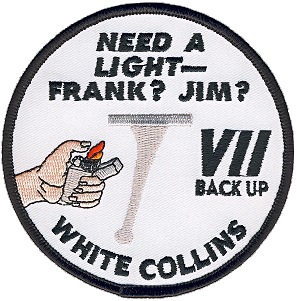
Backup Crew
|

alternative crew photoalternative crew photo |
|||||||||||||||
 |
||||||||||||||||
Hardware
| Launch vehicle: | Titan II GLV No. GT-7 (62-12562) |
| Spacecraft: | Gemini 7 (S/C-7 No. 1858) |
Flight
|
Launch from Cape Canaveral; landing 1200 km
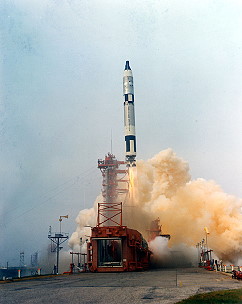
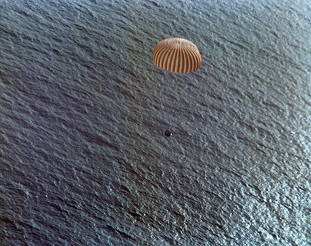
southwest of the Bermuda Islands in the Atlantic Ocean. The Gemini spacecraft was a cone-shaped capsule consisting of two components, a reentry module and an adaptor module. The adaptor module made up the base of the spacecraft. It was a truncated cone 228.6 cm high, 304.8 cm in diameter at the base and 228.6 cm at the upper end where it attached to the base of the reentry module. The re-entry module consisted of a truncated cone which decreased in diameter from 228.6 cm at the base to 98.2 cm, topped by a short cylinder of the same diameter and then another truncated cone decreasing to a diameter of 74.6 cm at the flat top. The reentry module was 345.0 cm high, giving a total height of 573.6 cm for the Gemini spacecraft. The adaptor module was an externally skinned, stringer framed structure, with magnesium stringers and an aluminum alloy frame. The adaptor was composed of two parts, an equipment section at the base and a retrorocket section at the top. The equipment section held fuel and propulsion systems and was isolated from the retrorocket section by a fiber-glass sandwich honeycomb blast shield. The retrorocket section held the re-entry rockets for the capsule. The reentry module consisted mainly of the pressurized cabin which held the two Gemini astronauts. Separating the reentry module from the retrorocket section of the adaptor at its base was a curved silicone elastomer ablative heat shield. The module was composed predominantly of titanium and nickel-alloy with beryllium shingles. At the narrow top of the module was the cylindrical reentry control system section and above this the rendezvous and recovery section which holds the reentry parachutes. The cabin held two seats equipped with emergency ejection devices, instrument panels, life support equipment, and equipment stowage compartments in a total pressurized volume of about 2.25 cubic meters. Two large hatches with small windows could be opened outward, one positioned above each seat. Attitude control was effected by two translation-maneuver hand controllers, an attitude controller, redundant horizon sensor systems, and reentry control electronics, with guidance provided via an inertial measuring unit and radar system. The orbital attitude and maneuver system used a hypergolic propellant combination of monomethyl hydrazine and nitrogen tetroxide supplied to the engines by a helium system pressurized at 2800 psi. Two 95 lb translation thrusters and eight 23 lb attitude thrusters were mounted along the bottom rim of the adaptor, and two 79 lb and 4 95 lb thrusters were mounted at the front of the adaptor. Power was supplied by 3 silver-zinc batteries to a 22- to 30-volt DC two-wire system. During reentry and post-landing power was supplied by four 45 amp-hr silver-zinc batteries. Voice communications were performed at 296.9 MHz with an output power of 3 W. A backup transmitter-receiver at 15.016 MHz with an output power of 5 W was also available. Two antenna systems consisting of quarter-wave monopoles were used. Telemetry was transmitted via three systems, one for real time telemetry, one for recorder playback, and a spare. Each system was frequency-modulated with a minimum power of 2 W. Spacecraft tracking consisted of two C-band radar transponders and an acquisition-aid beacon. One transponder is mounted in the adaptor with a peak power output of 600 W to a slot antenna on the bottom of the adaptor. The other is in the reentry section, delivering 1000 W to three helical antennas mounted at 120-degree intervals just forward of the hatches. The acquisition-aid beacon was mounted on the adaptor and had a power of 250 mW. At the time of reentry, the spacecraft would be maneuvered to the appropriate orientation and equipment adaptor section would be detached and jettisoned, exposing the retrorocket module. The retrorockets consisted of four spherical-case polysulfide ammonium perchlorate solid-propellant motors mounted near the center of the reentry adaptor module, each with 11,070 N thrust. They would fire to initiate the spacecraft reentry into the atmosphere, with attitude being maintained by a reentry control system of 16 engines, each with 5.2 N thrust. The retrorocket module would then be jettisoned, exposing the heat shield at the base of the reentry module. Along with the ablative heat shield, thermal protection during reentry was provided by thin Rene 41 radiative shingles at the base of the module and beryllium shingles at the top. Beneath the shingles was a layer of MIN-K insulation and thermoflex blankets. At an altitude of roughly 15,000 meters the astronauts would deploy a 2.4-meter drogue chute from the rendezvous and recovery section. At 3230 meters altitude the crew releases the drogue which extracts the 5.5-meter pilot parachute. The rendezvous and recovery section are released 2.5 seconds later, deploying the 25.6-meter main ring-sail parachute which is stored in the bottom of the section. The spacecraft is then rotated from a nose-up to a 35-degree angle for water landing. At this point a recovery beacon is activated, transmitting via an HF whip antenna mounted near the front of the reentry module. Gemini 7 was launched from Complex 19 at 19:30:03.702 UTC on December 04, 1965 and inserted into a 161.6 x 328.2 km orbit at 19:36:11 UTC. Main objectives for Gemini 7 were a long duration flight and a rendezvous with the later launched Gemini 6A. Gemini 7 was originally intended to fly after Gemini 6A, but the original Gemini 6 mission was cancelled after the failure during launch of the Agena Target Vehicle with which it was meant to rendezvous and dock. The objective of rendezvous was so important, that it was decided to fly Gemini 6A at the same time as Gemini 7, using the latter as the rendezvous target. After separating from the spent rocket stage, they turned the spacecraft around and tried to perform a rendezvous maneuver with the rocket stage. They spent fifteen minutes formation flying with the stage (closest approach about 6m), but the rocket stage vented its own fuel and that maneuver was stopped. Gemini 6A launched December 15, 1965, after a three-day-long delay due to a malfunction and engine shutdown immediately after ignition. It entered into an 87-by-140-nautical-mile (161 by 260 km) orbit, and was briefly visible from Gemini 7 just after launch. Successful was another rendezvous maneuver with the later launched spacecraft Gemini 6A. For 270 minutes the crews moved as close as 30 centimeters, talking over the radio. Several stationkeeping maneuvers (cycling each other, approaching, backing off) were performed. This was a really milestone of human spaceflight. For the first time the astronauts slept and worked together. Their sleep periods were scheduled at the same time unlike previous missions and they were able to get some sleep. 20 experiments were planned, only two of them had been cancelled, but there were only four new experiments. One of the new biological experiments was "Bioassays of Body Fluids". Its purpose was to study the effect of space flight on body fluid chemistries. Other medical experiments were for example calcium balance study and inflight sleep analysis. Both astronauts set a new flight duration record by that time. The last three days in space the mission began to drag. While in drifting flight, both astronauts read some of their books (authors: Mark Twain and Walter D. Edmonds). There were a few problems during the flight. The astronauts again had problems with the fuel cells und several thrusters worked poorly. A just-used urine collection bag split open early in the mission. The crew never managed to collect all the floating globules, but James Lovell later described this flight as '...two weeks in the Men's Room' - not very comfortable. The reentry was performed without any problems only 12 km of the targeted landing point. The crew was brought to the USS Wasp. |
Photos / Graphics
 |
 |
 |
 |
 |
 |
 |
 |
 |
 |
 |
 |
 |
 |
 |
 |
| © |  |
Last update on August 11, 2020.  |
 |