Human Orbital Spaceflights

International Flight No. 22Gemini 12USA |
 |
 |
Launch, orbit and landing data
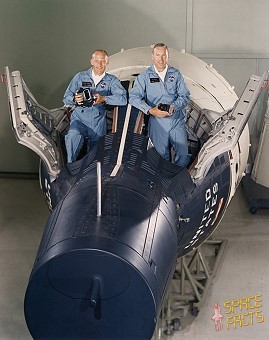
walkout photo |
 |
||||||||||||||||||
Crew
| No. | Surname | Given names | Position | Flight No. | Duration | Orbits | |
| 1 |  |
Lovell | James Arthur, Jr. "Shaky" | Command Pilot | 2 | 3d 22h 34m 30s | 59 |
| 2 | |
Aldrin | Edwin Eugene "Buzz" | PLT | 1 | 3d 22h 34m 30s | 59 |
Crew seating arrangement
|
 |
Backup Crew
|
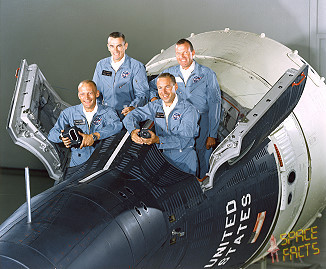
alternative crew photo |
||||||||||||||||
 |
|||||||||||||||||
Hardware
| Launch vehicle: | Titan II GLV No. GT-12 (62-12567) |
| Spacecraft: | Gemini 12 (S/C-12 No. 1853) |
Flight
|
Launch from Cape Canaveral and landing 1130 km
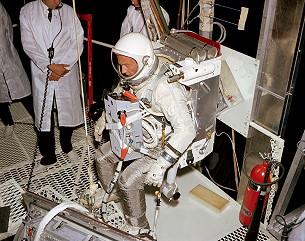
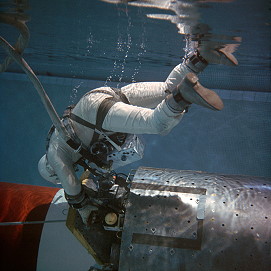
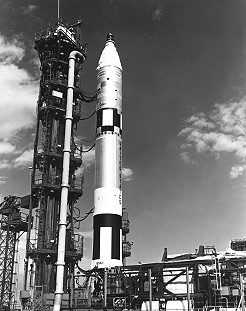
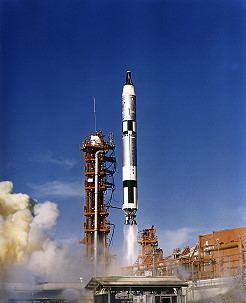
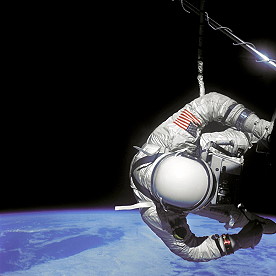
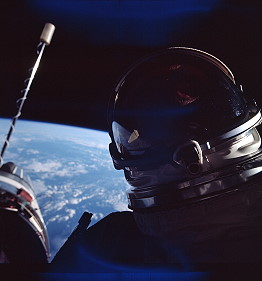
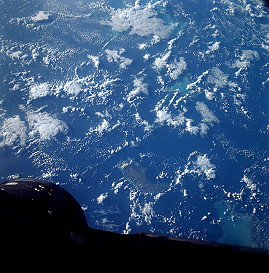
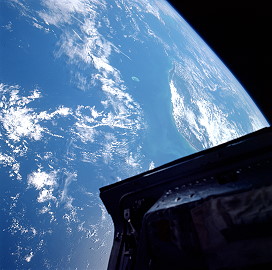
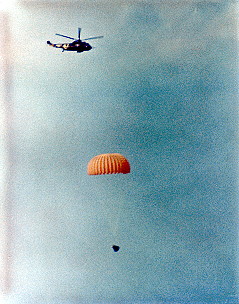
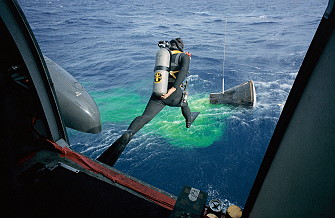
southeast from Cape Canaveral in the Atlantic Ocean. The Gemini spacecraft was a cone-shaped capsule consisting of two components, a reentry module and an adaptor module. The adaptor module made up the base of the spacecraft. It was a truncated cone 228.6 cm high, 304.8 cm in diameter at the base and 228.6 cm at the upper end where it attached to the base of the reentry module. The re-entry module consisted of a truncated cone which decreased in diameter from 228.6 cm at the base to 98.2 cm, topped by a short cylinder of the same diameter and then another truncated cone decreasing to a diameter of 74.6 cm at the flat top. The reentry module was 345.0 cm high, giving a total height of 573.6 cm for the Gemini spacecraft. The adaptor module was an externally skinned, stringer framed structure, with magnesium stringers and an aluminum alloy frame. The adaptor was composed of two parts, an equipment section at the base and a retrorocket section at the top. The equipment section held fuel and propulsion systems and was isolated from the retrorocket section by a fiber-glass sandwich honeycomb blast shield. The retrorocket section held the re-entry rockets for the capsule. The reentry module consisted mainly of the pressurized cabin which held the two Gemini astronauts. Separating the reentry module from the retrorocket section of the adaptor at its base was a curved silicone elastomer ablative heat shield. The module was composed predominantly of titanium and nickel-alloy with beryllium shingles. At the narrow top of the module was the cylindrical reentry control system section and above this the rendezvous and recovery section which holds the reentry parachutes. The cabin held two seats equipped with emergency ejection devices, instrument panels, life support equipment, and equipment stowage compartments in a total pressurized volume of about 2.25 cubic meters. Two large hatches with small windows could be opened outward, one positioned above each seat. Attitude control was effected by two translation-maneuver hand controllers, an attitude controller, redundant horizon sensor systems, and reentry control electronics, with guidance provided via an inertial measuring unit and radar system. The orbital attitude and maneuver system used a hypergolic propellant combination of monomethyl hydrazine and nitrogen tetroxide supplied to the engines by a helium system pressurized at 2800 psi. Two 95 lb translation thrusters and eight 23 lb attitude thrusters were mounted along the bottom rim of the adaptor, and two 79 lb and 4 95 lb thrusters were mounted at the front of the adaptor. Power was supplied by 3 silver-zinc batteries to a 22- to 30-volt DC two-wire system. During reentry and post-landing power was supplied by four 45 amp-hr silver-zinc batteries. Voice communications were performed at 296.9 MHz with an output power of 3 W. A backup transmitter-receiver at 15.016 MHz with an output power of 5 W was also available. Two antenna systems consisting of quarter-wave monopoles were used. Telemetry was transmitted via three systems, one for real time telemetry, one for recorder playback, and a spare. Each system was frequency-modulated with a minimum power of 2 W. Spacecraft tracking consisted of two C-band radar transponders and an acquisition-aid beacon. One transponder is mounted in the adaptor with a peak power output of 600 W to a slot antenna on the bottom of the adaptor. The other is in the reentry section, delivering 1000 W to three helical antennas mounted at 120-degree intervals just forward of the hatches. The acquisition-aid beacon was mounted on the adaptor and had a power of 250 mW. At the time of reentry, the spacecraft would be maneuvered to the appropriate orientation and equipment adaptor section would be detached and jettisoned, exposing the retrorocket module. The retrorockets consisted of four spherical-case polysulfide ammonium perchlorate solid-propellant motors mounted near the center of the reentry adaptor module, each with 11,070 N thrust. They would fire to initiate the spacecraft reentry into the atmosphere, with attitude being maintained by a reentry control system of 16 engines, each with 5.2 N thrust. The retrorocket module would then be jettisoned, exposing the heat shield at the base of the reentry module. Along with the ablative heat shield, thermal protection during reentry was provided by thin Rene 41 radiative shingles at the base of the module and beryllium shingles at the top. Beneath the shingles was a layer of MIN-K insulation and thermoflex blankets. At an altitude of roughly 15,000 meters the astronauts would deploy a 2.4-meter drogue chute from the rendezvous and recovery section. At 3230 meters altitude the crew releases the drogue which extracts the 5.5-meter pilot parachute. The rendezvous and recovery section are released 2.5 seconds later, deploying the 25.6-meter main ring-sail parachute which is stored in the bottom of the section. The spacecraft is then rotated from a nose-up to a 35-degree angle for water landing. At this point a recovery beacon is activated, transmitting via an HF whip antenna mounted near the front of the reentry module. The Gemini Agena Target Vehicle (GATV) was designed to be launched into Earth orbit prior to a Gemini mission and used for rendezvous and docking practice. The GATV had a docking cone at the forward end into which the nose of the Gemini spacecraft could be inserted and held with docking latches. The GATV was a 6-meter-long cylinder with a diameter of 4.9 meters. The primary and secondary propulsion systems were at the back end of the target vehicle with the attitude control gas tanks and the main propellant tanks. The docking cone was connected to the front end by shock absorbing dampers. Acquisition running lights and target vehicle status display indicators were situated on the front end. A 2.1-meter-long retractable L-band boom antenna extended from the side of the cylinder near the front. Tracking and command of the GATV were also aided by a rendezvous beacon, two spiral L-band antennas, two tracking antennas (C-band and S-band), two VHF telemetry antennas, and a UHF command antenna. Micrometeoroid packages and other experiments could also be mounted on the GATV. The Gemini 12 Agena Target Vehicle (GATV-12) was launched from Cape Canaveral at 19:07:58.688 UTC on November 11, 1966 into a near-circular 300 km orbit using an Atlas-Agena D rocket. During the target vehicle ascent maneuver, 140 seconds after primary propulsion system initiation, a 30-psi drop occurred in thrust chamber pressure for 1 second, then returned to normal for the remaining 42 seconds of firing. The anomaly did not affect the GATV-12 orbit insertion, but uncertainties about the significance of the pressure drop caused cancellation of the plan to use the primary propulsion system to lift the spacecraft into higher orbit after docking with Gemini 12. Gemini 12 was the final Gemini mission. The major objectives of this mission were nearly the same as for Gemini 11. Gemini 12 was designed to perform rendezvous and docking with the Agena target vehicle, to conduct three extra-vehicular activity (EVA) operations, to conduct a tethered stationkeeping exercise, to perform docked maneuvers using the Agena propulsion system to change orbit, and demonstrate an automatic reentry. In preparation for this mission, new, improved restraints were added to the outside of the capsule, and a new technique underwater training was introduced, which would become a staple of all future spacewalk simulation. Gemini 12 was launched from Complex 19 on November 11, 1966 at 20:46:33.419 UTC and inserted into a 160.8 x 270.6 km Earth orbit at 20:52:40 UTC. The docking with the unmanned Agena target vehicle GATV-12 was successful at 01:00:03 UTC, even there were problems with the rendezvous radar. For the second time, a Gemini crew was able to practice docking and undocking. The climb to a higher orbit, however, was cancelled because of a problem with the Agena booster. There was also a malfunction with the fuel's cells in the Gemini capsule. Buzz Aldrin performed three EVAs during one flight, which was a new record. The first (stand-up EVA) was on November 12, 1966 (2h 29m). Buzz Aldrin emerged in orbital daylight and installed the S13 ultraviolet astronomical camera. He evaluated standup EVA dynamics until after dark, then performed astronomical photography. Shortly after the Gemini 12-Agena 12 combination flashed orange in the brief orbital dawn, Buzz Aldrin installed a camera to record his activities, then prepared for the next EVA by installing a handbar and unfolding a handrail. He changed a diffraction grating on the S13 camera and removed the S12 micrometeoroid package from behind the cockpit. James Lovell assisted Buzz Aldrin in his tasks. Just before orbital sunset he retrieved the EVA camera. Buzz Aldrin resumed astronomical photography as darkness fell again. He witnessed a second orbital sunrise before closing the hatch on his successful first EVA. The second spacewalk, an umbilical EVA, was performed on November 13, 1966 (2h 06m). To start this EVA, Buzz Aldrin moved to the Target Docking Adapter on Agena 12, where he used waist tethers to hold position. Attaching a 100-feet (30.48 meter) tether on the Agena to Gemini 12 proved surprisingly easy with both hands free. He then moved back to the adapter section, where he slipped his feet into "golden slipper" foot restraints. He used waist tethers to position himself at a work station for testing representative tasks - he cut cables and fluid lines, fastened rings and hooks, connected and disconnected electrical and fluid connectors, tightened bolts, and stripped velcro. Buzz Aldrin's physical condition was closely monitored so that he could be advised to rest before fatigue developed. He moved to a similar work station on the Agena docking adapter where he tested an Apollo torque wrench with and without tethers. He wiped James Lovell's window and observed thruster firings on Gemini 12, then closed the hatch on the world's first successful complex EVA. The final EVA, again a stand-up EVA, was performed on November 14, 1966 (1h 11m), in which he jettisoned disused equipment just before orbital sunset and snapped several ultraviolet photographs of constellations. The 14 scientific experiments were frog egg growth under zero-g, synoptic terrain photography, synoptic weather photography, nuclear emulsions, airglow horizon photography, UV astronomical photography, and dim sky photography. Two micrometeorite collection experiments, as well as three space phenomena photography experiments, were not fully completed. It was again an automatic controlled reentry, only 5,5 km far from the recovery ship, the carrier USS Wasp. |
EVA data
| Name | Start | End | Duration | Mission | Airlock | Suit | Stripes | |
| SEVA | Aldrin, Buzz | 12.11.1966, 16:16 UTC | 12.11.1966, 18:45 UTC | 2h 29m | Gemini 12 | G4C No. 42 | without | |
| IVA | Lovell, James | 12.11.1966, 16:16 UTC | 12.11.1966, 18:45 UTC | 2h 29m | Gemini 12 | G4C No. 41 | without | |
| EVA | Aldrin, Buzz | 13.11.1966, 15:35 UTC | 13.11.1966, 17:41 UTC | 2h 06m | Gemini 12 | G4C No. 42 | without | |
| IVA | Lovell, James | 13.11.1966, 15:35 UTC | 13.11.1966, 17:41 UTC | 2h 06m | Gemini 12 | G4C No. 41 | without | |
| SEVA | Aldrin, Buzz | 14.11.1966, 14:53 UTC | 14.11.1966, 15:48 UTC | 1h 11m | Gemini 12 | G4C No. 42 | without | |
| IVA | Lovell, James | 14.11.1966, 14:53 UTC | 14.11.1966, 15:48 UTC | 1h 11m | Gemini 12 | G4C No. 41 | without | |
Photos / Graphics
 |
 |
 |
 |
 |
 |
 |
 |
 |
 |
 |
 |
 |
 |
 |
 |
 |
 |
 |
 |
 |
 |
 |
|
more Earth observation photos |
|
more EVA photos |
|
| © |  |
Last update on March 01, 2026.  |
 |