Human Spaceflights to the Moon

International Flight No. 30Apollo 10USA |
 |
 |
Launch, orbit and landing data
walkout photo |
 |
|||||||||||||||||||||||||||
alternative crew photo |
alternative crew photo |
|||||||||||||||||||||||||||
alternative crew photo |
alternative crew photo |
|||||||||||||||||||||||||||
alternative crew photo |
alternative crew photo |
|||||||||||||||||||||||||||
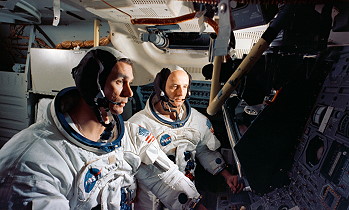
Crew
| No. | Surname | Given names | Position | Flight No. | Duration | Orbits | |
| 1 |  |
Stafford | Thomas Patten "Tom" | CDR | 3 | 8d 00h 03m 22s | 1,5 |
| 2 | |
Young | John Watts | CMP | 3 | 8d 00h 03m 22s | 1,5 |
| 3 | |
Cernan | Eugene Andrew "Gene" | LMP | 2 | 8d 00h 03m 22s | 1,5 |
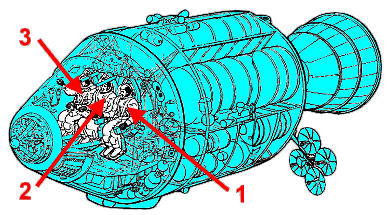
Crew seating arrangement
|
 |
|
||||||||||||||||
Backup Crew
|
 |
Support Crew
|
||||||||||||||||
Hardware
| Launch vehicle: | Saturn V (SA-505) |
| Spacecraft: | Apollo (CSM-106 „Charlie Brown“ / LM-4 „Snoopy“) |
Flight
|
Launch from Cape Canaveral (KSC) and
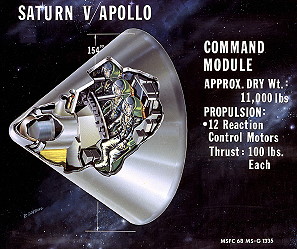
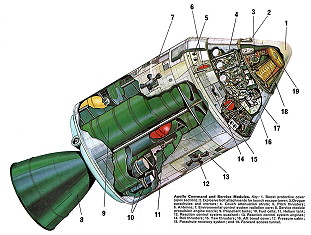
landing east of Samoa Islands in the Pacific Ocean. The Command Module (CM) was a conical pressure vessel with a maximum diameter of 3.9 m at its base and a height of 3.65 m. It was made of an aluminum honeycomb sandwich bonded between sheet aluminum alloy. The base of the CM consisted of a heat shield made of brazed stainless steel honeycomb filled with a phenolic epoxy resin as an ablative material and varied in thickness from 1.8 to 6.9 cm. At the tip of the cone was a hatch and docking assembly designed to mate with the lunar module. The CM was divided into three compartments. The forward compartment in the nose of the cone held the three 25.4 m diameter main parachutes, two 5 m drogue parachutes, and pilot mortar chutes for Earth landing. The aft compartment was situated around the base of the CM and contained propellant tanks, reaction control engines, wiring, and plumbing. The crew compartment comprised most of the volume of the CM, approximately 6.17 cubic meters of space. Three astronaut couches were lined up facing forward in the center of the compartment. A large access hatch was situated above the center couch. A short access tunnel led to the docking hatch in the CM nose. The crew compartment held the controls, displays, navigation equipment and other systems used by the astronauts. The CM had five windows: one in the access hatch, one next to each astronaut in the two outer seats, and two forward-facing rendezvous windows. Five silver/zinc-oxide batteries provided power after the CM and SM detached, three for re-entry and after landing and two for vehicle separation and parachute deployment. The CM had twelve 420 N nitrogen tetroxide/hydrazine reaction control thrusters. The CM provided the re-entry capability at the end of the mission after separation from the Service Module. The Service Module (SM) was a cylinder 3.9 meters in diameter and 7.6 m long which was attached to the back of the CM. The outer skin of the SM was formed of 2.5 cm thick aluminum honeycomb panels. The interior was divided by milled aluminum radial beams into six sections around a central cylinder. At the back of the SM mounted in the central cylinder was a gimbal mounted re-startable hypergolic liquid propellant 91,000 N engine and cone shaped engine nozzle. Attitude control was provided by four identical banks of four 450 N reaction control thrusters each spaced 90 degrees apart around the forward part of the SM. The six sections of the SM held three 31-cell hydrogen oxygen fuel cells which provided 28 volts, two cryogenic oxygen and two cryogenic hydrogen tanks, four tanks for the main propulsion engine, two for fuel and two for oxidizer, and the subsystems the main propulsion unit. Two helium tanks were mounted in the central cylinder. Electrical power system radiators were at the top of the cylinder and environmental control radiator panels spaced around the bottom. The lunar module (LM) was a two-stage vehicle designed for space operations near and on the Moon. The spacecraft mass of 15,065 kg was the mass of the LM including astronauts, propellants and expendables. The dry mass of the ascent stage was 2180 kg and it held 2639 kg of propellant. The descent stage dry mass was 2034 kg and 8212 kg of propellant were onboard initially. The ascent and descent stages of the LM operated as a unit until staging, when the ascent stage functioned as a single spacecraft for rendezvous and docking with the command and service module (CSM). The descent stage comprised the lower part of the spacecraft and was an octagonal prism 4.2 meters across and 1.7 m thick. Four landing legs with round footpads were mounted on the sides of the descent stage and held the bottom of the stage 1.5 m above the surface. The distance between the ends of the footpads on opposite landing legs was 9.4 m. One of the legs had a small astronaut egress platform and ladder. A one meter long conical descent engine skirt protruded from the bottom of the stage. The descent stage contained the landing rocket, two tanks of aerozine 50 fuel, two tanks of nitrogen tetroxide oxidizer, water, oxygen and helium tanks and storage space for the lunar equipment and experiments, and in the case of Apollo 15, 16, and 17, the lunar rover. The descent stage served as a platform for launching the ascent stage and was left behind on the Moon. The ascent stage was an irregularly shaped unit approximately 2.8 m high and 4.0 by 4.3 meters in width mounted on top of the descent stage. The ascent stage housed the astronauts in a pressurized crew compartment with a volume of 6.65 cubic meters which functioned as the base of operations for lunar operations. There was an ingress-egress hatch in one side and a docking hatch for connecting to the CSM on top. Also mounted along the top were a parabolic rendezvous radar antenna, a steerable parabolic S-band antenna, and 2 in-flight VHF antennas. Two triangular windows were above and to either side of the egress hatch and four thrust chamber assemblies were mounted around the sides. At the base of the assembly was the ascent engine. The stage also contained an aerozine 50 fuel and an oxidizer tank, and helium, liquid oxygen, gaseous oxygen, and reaction control fuel tanks. There were no seats in the LM. A control console was mounted in the front of the crew compartment above the ingress-egress hatch and between the windows and two more control panels mounted on the side walls. The ascent stage was launched from the Moon at the end of lunar surface operations and returned the astronauts to the CSM. The descent engine was a deep-throttling ablative rocket with a maximum thrust of about 45,000 N mounted on a gimbal ring in the center of the descent stage. The ascent engine was a fixed, constant-thrust rocket with a thrust of about 15,000 N. Maneuvering was achieved via the reaction control system, which consisted of the four thrust modules, each one composed of four 450 N thrust chambers and nozzles pointing in different directions. Telemetry, TV, voice, and range communications with Earth were all via the S-band antenna. VHF was used for communications between the astronauts and the LM, and the LM and orbiting CSM. There were redundant transceivers and equipment for both S-band and VHF. An environmental control system recycled oxygen and maintained temperature in the electronics and cabin. Power was provided by 6 silver-zinc batteries. Guidance and navigation control were provided by a radar ranging system, an inertial measurement unit consisting of gyroscopes and accelerometers, and the Apollo guidance computer. Apollo 10 was the final dress rehearsal for the moon landing and the second manned lunar orbital mission, but first lunar orbital mission with the complete spacecraft (including the lunar module). Apollo 10 launched from Cape Kennedy on May 18, 1969, into a nominal 115-mile (185 kilometers) circular Earth-parking orbit at an inclination of 32.5 degrees. One-and-a-half orbits later, translunar injection occurred. The S-IVB fired to increase velocity from 25,593 to 36,651 feet (7,800 to 11,171 meters) per second on a free-return trajectory. Twenty-five minutes later, the CSM separated for transposition and docking with the LM, similar to the maneuver performed on Apollo 9. The orbital vehicle was comprised of the S-IVB stage, and its payload of the CSM, the LM and spacecraft-lunar module adapter The launch trajectory had been so satisfactory that only one of four midcourse corrections was needed. This was accomplished 26.5 hours into the flight. About 76 hours into the mission, lunar-orbit insertion occurred with the firing of the service propulsion system, or SPS. A second firing of the engine 4.5 hours later circularized the lunar orbit of Apollo 10 at approximately 69 miles (111 kilometers), which was followed by the first color TV pictures to Earth of the moon's surface. On May 22, 1969 the spacecraft were separated. Spacecraft and the LM, named Snoopy, with Thomas Stafford and Eugene Cernan onboard was inserted into a descent orbit, John Young remained alone in his command module "Charlie Brown". The LM was taken within 15.243 km of the lunar surface, checking out the LMs radar and ascent engine and several more. The LM flew over Landing Site 2 in the Sea of Tranquility. During this run, the LM landing radar was tested for altitude functioning, providing both "high gate" and "low gate" data. Following a 7.5-second firing of the LM reaction control system, or RCS, thrusters, the descent engine fired in two bursts for 40.1 seconds - at 10 percent and at full throttle - placing the LM into an orbit of 13.7 by 219 miles (22.05 by 352.45 kilometers). On the 14th revolution, it reached a pericynthion of 12.7 miles (20.4 kilometers) and was "staged". Upon separation of the descent stage and ascent engine ignition, the Lunar Module began to roll violently due to the crew accidentally duplicating commands into the flight computer which took the LM out of abort mode, the correct configuration for this maneuver. The live network broadcasts caught Eugene Cernan and Thomas Stafford uttering several expletives before regaining control of the LM. Eugene Cernan has said he observed the horizon spinning eight times over, indicating eight rolls of the spacecraft under ascent engine power. While the incident was downplayed by NASA, the roll was just several revolutions from being unrecoverable, which would have resulted in the LM crashing into the lunar surface. An incorrect switch setting was the reason for the unexpected LM motion. Finally, the lunar module returned to dock successfully with the CSM following the eight-hour separation, and the LM crew returned to the CSM. The LM ascent stage was jettisoned. The rest of the time in lunar orbit was spent on landmark tracking and photography. On the 31st orbit, the SPS restarted. Apollo 10 was on the back side of the moon when it was injected into a trans-Earth trajectory. Apollo 10 also added another first - broadcasting live color TV from space (19 different broadcasts were performed). The splashdown was 5.4 kilometers from the recovery ship USS Princeton. |
Photos / Graphics
 |
 |
|
Source: www.astronautix.com/ |
|
 |
 |
 |
 |
 |
 |
 |
 |
 |
 |
 |
 |
 |
 |
 |
 |
 |
 |
 |
 |
 |
 |
 |
|
more Moon observation photos |
|
| © |  |
Last update on August 11, 2020.  |
 |